
Cold Room Mould Removal in Toronto & the GTA
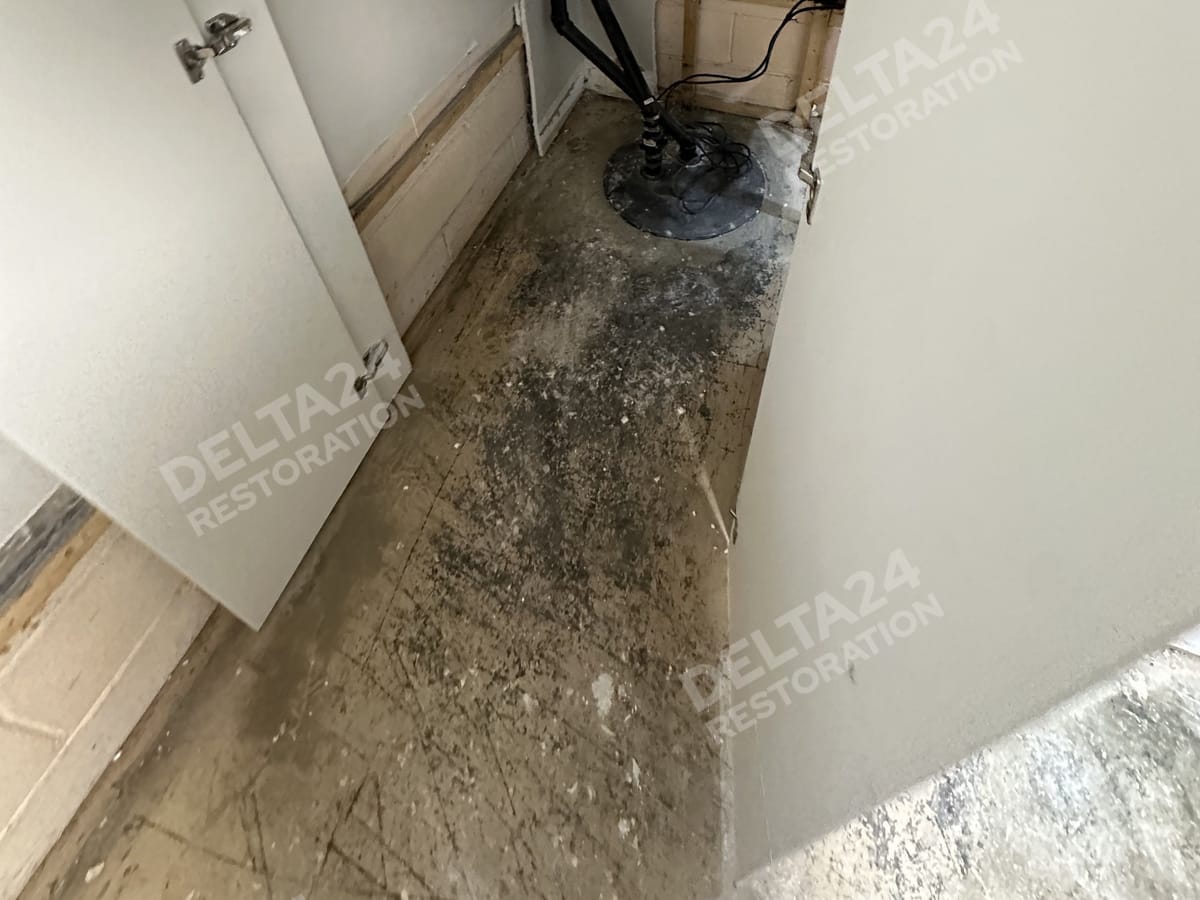
The cold room under the front porch is one of the most common places we find mould in older GTA houses. It is a concrete box with the porch slab as its ceiling, usually with no insulation, little or no ventilation, and wooden shelving holding cardboard and preserves.
Two things feed it: water leaking through a cracked or poorly sloped porch slab, and warm basement air condensing on the cold concrete. We find out which it is before anything is removed, because cleaning without fixing the source means it returns by the next winter.
Covered by insurance? We bill your insurer directly, so in most cases you pay only your deductible. What your policy covers →
Signs of cold room mould
- A musty smell when the cold room door is opened
- White, green or black growth on wooden shelving or the door frame
- Staining or dripping from the concrete ceiling (the porch slab)
- Efflorescence: white chalky deposits on the walls
- Rusted rebar or spalling concrete overhead
- Condensation on walls in spring and fall
- Stored cardboard boxes that feel damp or have gone soft
What the job includes
- Moisture mapping of walls and slab to find leak versus condensation
- Containment and negative air so spores do not spread into the basement
- Removal of contaminated shelving, cardboard and other porous items
- HEPA vacuuming and cleaning of the concrete surfaces
- Advice or repair for the porch slab: sealing, re-sloping or membrane
- Ventilation or controlled dehumidification of the room
- Correct treatment of the cold room door: sealed and insulated
- Written verification on completion
Who we do this for
- Owners of older detached and semi-detached homes
- Buyers whose inspection flagged the cold room
- Sellers preparing a house for listing
- Landlords with basement units
When to call us
When you smell it or see it on the shelving. A cold room is rarely an emergency, but it opens into the basement, so a bad one affects the air there and in any basement apartment.
Three steps
You call, we pick up
A person answers at any hour. Tell us what you are looking at and we will tell you what to do first.
We attend and stabilise
Usually within 45 minutes. We stop the damage getting worse before anything else happens.
We finish and bill your insurer
Documented daily, completed properly, invoiced to your insurer rather than to you.
What cold room mould removal costs you
We bill your insurance company directly. On most covered losses that is the only amount you pay us.
Water damage is the most common home insurance claim in Ontario, and the great majority of the work we do is paid by an insurer rather than by the property owner. We document every loss from the first hour with moisture readings, photographs and a written scope, which is the evidence an adjuster needs to approve the work without argument or delay.
We work with all major Canadian insurers and handle the claim from start to finish, including the adjuster's questions. If you are not insured, or the loss falls outside your policy, we will give you a clear written quote before any work begins and we will tell you honestly what can be dried and saved rather than replaced. Keeping material in place is what keeps the cost down, and it is the first thing we look at.
There is no charge for attending to assess an emergency, and no obligation once we have. What your policy covers →
Who turns up
Delta24 Restoration is a professional restoration contractor serving Toronto and the Greater Toronto Area. Our technicians are certified by the IICRC, the industry standards body for the restoration trade, in Water Damage Restoration (WRT) and Applied Structural Drying (ASD). We are WSIB cleared and carry full commercial general liability insurance. Certificate numbers and a current clearance certificate are provided on request, and property managers and adjusters routinely ask for both before we attend.
We work to the IICRC S500 standard for water damage restoration and the S520 standard for mould remediation. Every job is documented with daily moisture readings, photographs and a written scope, which is why adjusters approve our work without delay.
Asbestos work is carried out to Ontario Regulation 278/05, which sets out the procedures for Type 1, Type 2 and Type 3 operations. Mould work finishes with written post-remediation verification, which is the document a buyer, a lender or an insurer will ask to see.
- IICRC WRT certified technicians
- IICRC ASD certified drying
- WSIB cleared, certificate on request
- Commercial general liability insurance
- Asbestos work to O. Reg. 278/05
- Direct billing with all major Canadian insurers
- Years of insurance claim experience with every major insurer
- Written post-remediation verification on mould work
- Free assessment, no obligation
How the insurance side works
Water damage is the most common home insurance claim in Ontario, and how the claim is handled usually matters more to your bill than the work itself. We document the loss from the first hour: moisture readings, photographs, a written scope, and a daily drying log. That is the evidence an adjuster needs to approve the work without arguing about it.
We bill your insurer directly. In most cases the only money you hand over is your deductible, which on Ontario policies commonly sits between $500 and $2,500.
Which losses are covered depends entirely on where the water came from. A burst pipe or a failed appliance is normally covered under a standard policy. Water coming up through a floor drain is sewer backup, which is almost always a separate endorsement you have to have purchased. Water entering from outside during heavy rain is overland flood, which is another endorsement again. A single storm can produce all three at once, which is why adjusters care so much about the source.
Full guide: is a flooded basement covered by insurance? →
How the claim works, and what your insurer covers →
Common questions
Why does my cold room get mouldy every year?
Almost always because the porch slab above it leaks, or because warm basement air condenses on the cold concrete. Bleach and a fan treat the symptom; the slab or the airflow is the cause.
Should I insulate my cold room?
Not from the inside without a plan. Insulating the walls on the inside can trap moisture against the concrete. Insulating and sealing the door between the cold room and the basement is usually the right move, and some homeowners choose to convert the room entirely.
Can the concrete be cleaned, or does it need replacing?
Concrete itself does not need replacing for mould; it is cleaned. A slab that is spalling or has exposed, rusting rebar is a structural repair and a separate question.
Is cold room mould covered by insurance?
Usually not, because it builds up gradually. If it followed a sudden covered event, it may form part of that claim.
Cold Room Mould Removal across the GTA
Pick your area for local detail: what the housing stock is like, why water gets in there, and the neighbourhoods we cover.