Kitchen Mould Removal in Toronto & the GTA
Kitchen mould nearly always starts with a slow leak you cannot see: a weeping supply line under the sink, a loose drain trap, a dishwasher hose, or the ice-maker line behind the fridge. It drips for weeks into the cabinet floor or the subfloor before anyone opens the door and smells it.
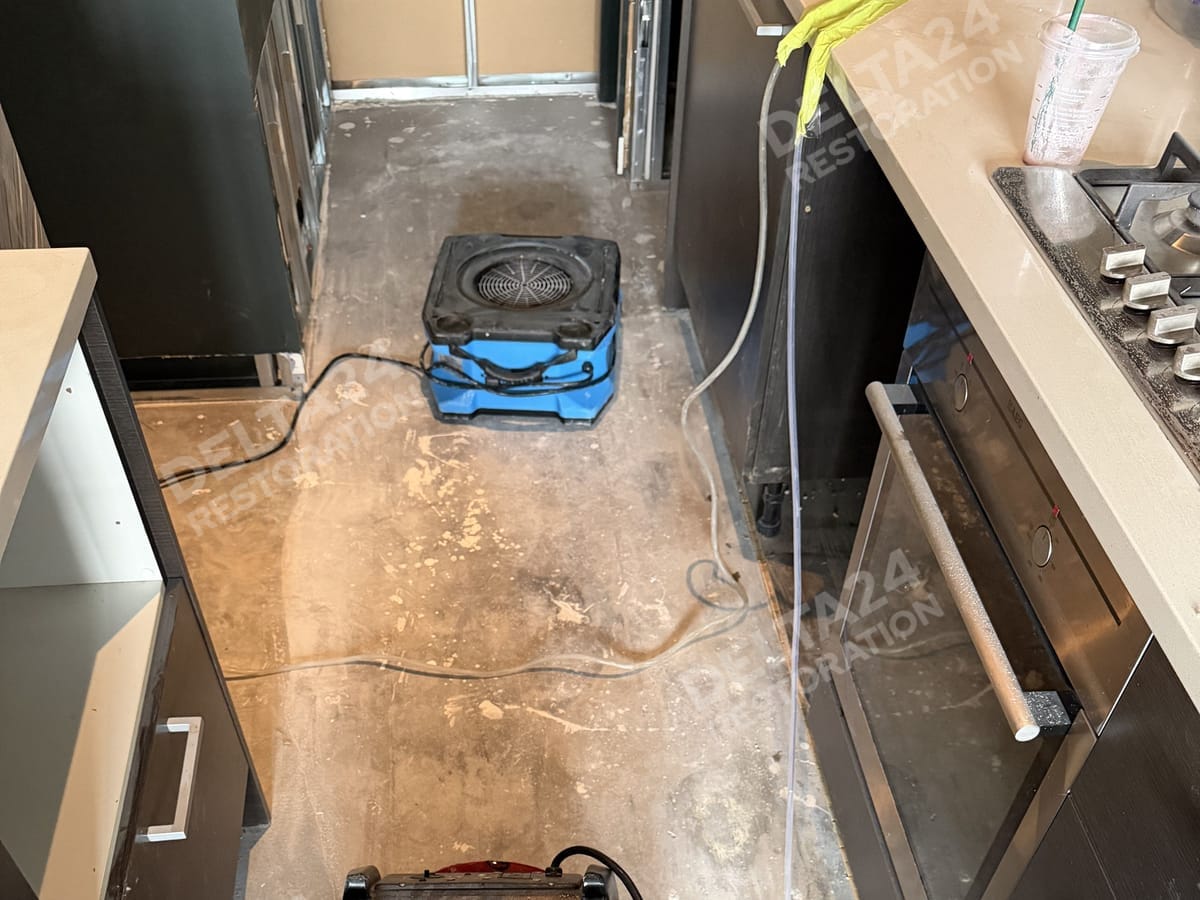
The cabinet base is usually particleboard, which swells and cannot be cleaned once it is wet through. We stop the leak, remove what is damaged, dry the floor and wall behind it, and put it back.
Covered by insurance? We bill your insurer directly, so in most cases you pay only your deductible. What your policy covers →
Signs of kitchen mould
- A musty smell when you open the cabinet under the sink
- A swollen, soft or stained cabinet floor
- Growth on the back wall of the sink cabinet
- Water marks or lifting flooring in front of the dishwasher
- A damp patch on the wall or floor behind the fridge
- Staining on the ceiling of the room below the kitchen
- Warped baseboards or toe kicks
What the job includes
- Leak detection at sink, dishwasher, fridge line and drains
- Containment and HEPA filtration
- Careful removal of the affected cabinet base, toe kick and drywall
- Moisture testing and drying of subfloor and wall cavity
- Cleaning and treatment of sound framing
- Coordination with your plumber or ours for the repair
- Reinstallation of cabinets and finishes through our reconstruction team
- Written verification on completion
Who we do this for
- Homeowners
- Condo owners, where a kitchen leak can reach the unit below
- Landlords
- Restaurants and commercial kitchens
When to call us
As soon as you find a wet or soft cabinet floor. The longer a slow leak runs, the further it travels under the flooring, and the more of the kitchen has to come apart.
Three steps
You call, we pick up
A person answers at any hour. Tell us what you are looking at and we will tell you what to do first.
We attend and stabilise
Usually within 45 minutes. We stop the damage getting worse before anything else happens.
We finish and bill your insurer
Documented daily, completed properly, invoiced to your insurer rather than to you.
What kitchen mould removal costs you
We bill your insurance company directly. On most covered losses that is the only amount you pay us.
Water damage is the most common home insurance claim in Ontario, and the great majority of the work we do is paid by an insurer rather than by the property owner. We document every loss from the first hour with moisture readings, photographs and a written scope, which is the evidence an adjuster needs to approve the work without argument or delay.
We work with all major Canadian insurers and handle the claim from start to finish, including the adjuster's questions. If you are not insured, or the loss falls outside your policy, we will give you a clear written quote before any work begins and we will tell you honestly what can be dried and saved rather than replaced. Keeping material in place is what keeps the cost down, and it is the first thing we look at.
There is no charge for attending to assess an emergency, and no obligation once we have. What your policy covers →
Who turns up
Delta24 Restoration is a professional restoration contractor serving Toronto and the Greater Toronto Area. Our technicians are certified by the IICRC, the industry standards body for the restoration trade, in Water Damage Restoration (WRT) and Applied Structural Drying (ASD). We are WSIB cleared and carry full commercial general liability insurance. Certificate numbers and a current clearance certificate are provided on request, and property managers and adjusters routinely ask for both before we attend.
We work to the IICRC S500 standard for water damage restoration and the S520 standard for mould remediation. Every job is documented with daily moisture readings, photographs and a written scope, which is why adjusters approve our work without delay.
Asbestos work is carried out to Ontario Regulation 278/05, which sets out the procedures for Type 1, Type 2 and Type 3 operations. Mould work finishes with written post-remediation verification, which is the document a buyer, a lender or an insurer will ask to see.
- IICRC WRT certified technicians
- IICRC ASD certified drying
- WSIB cleared, certificate on request
- Commercial general liability insurance
- Asbestos work to O. Reg. 278/05
- Direct billing with all major Canadian insurers
- Years of insurance claim experience with every major insurer
- Written post-remediation verification on mould work
- Free assessment, no obligation
How the insurance side works
Water damage is the most common home insurance claim in Ontario, and how the claim is handled usually matters more to your bill than the work itself. We document the loss from the first hour: moisture readings, photographs, a written scope, and a daily drying log. That is the evidence an adjuster needs to approve the work without arguing about it.
We bill your insurer directly. In most cases the only money you hand over is your deductible, which on Ontario policies commonly sits between $500 and $2,500.
Which losses are covered depends entirely on where the water came from. A burst pipe or a failed appliance is normally covered under a standard policy. Water coming up through a floor drain is sewer backup, which is almost always a separate endorsement you have to have purchased. Water entering from outside during heavy rain is overland flood, which is another endorsement again. A single storm can produce all three at once, which is why adjusters care so much about the source.
Full guide: is a flooded basement covered by insurance? →
How the claim works, and what your insurer covers →
Common questions
Can a mouldy sink cabinet be cleaned?
If the cabinet floor is solid wood and only surface-stained, sometimes. Particleboard that has swollen has to be replaced.
Do you have to remove the whole kitchen?
Rarely. Usually only the affected base cabinet comes out, with the flooring and drywall around it where moisture readings show they are wet.
Is it covered by insurance?
A sudden leak, such as a burst supply line or a failed dishwasher hose, is often covered. Damage from a leak that went on for a long time may be treated as gradual and excluded.
What about mould behind the fridge?
An ice-maker line leak behind the fridge is one of the most common kitchen losses. We check it whenever the floor there is stained or lifting.
Kitchen Mould Removal across the GTA
Pick your area for local detail: what the housing stock is like, why water gets in there, and the neighbourhoods we cover.