Basement Mould Removal in Vaughan
Plenty of Vaughan homes have finished basements and a second kitchen downstairs, which turns a flood into a much bigger job.
Vaughan is largely newer detached housing through Woodbridge, Maple and Vellore, with fully finished basements often including a second kitchen, a bathroom and bedrooms.
Sump pump failure and burst supply lines. Because the basements are fully finished, a modest volume of water reaches drywall, flooring and cabinetry almost immediately.
Basements combine everything mould needs: cool surfaces, humid air, and organic materials like drywall, wood framing and stored cardboard. Add a past flood that was never properly dried and growth is close to inevitable.
Covered by insurance? We bill your insurer directly, so in most cases you pay only your deductible.
Where we work in Vaughan
We cover the whole of Vaughan, including Woodbridge, Maple, Concord, Thornhill and every neighbourhood in between. Postal areas L3L, L4H, L4J, L4K, L4L, L6A.
Full neighbourhood list (11)
Signs of basement mould
- A musty smell noticeable at the bottom of the stairs
- Dark spotting on drywall near the floor
- White or fuzzy growth on joists or subfloor
- Efflorescence or damp patches on foundation walls
- Warped baseboards or trim
- Stored cardboard and fabric going musty
- Humidity that stays high through the summer
What the job includes
- Moisture investigation to identify the source
- Containment and negative air pressure
- HEPA air filtration during the work
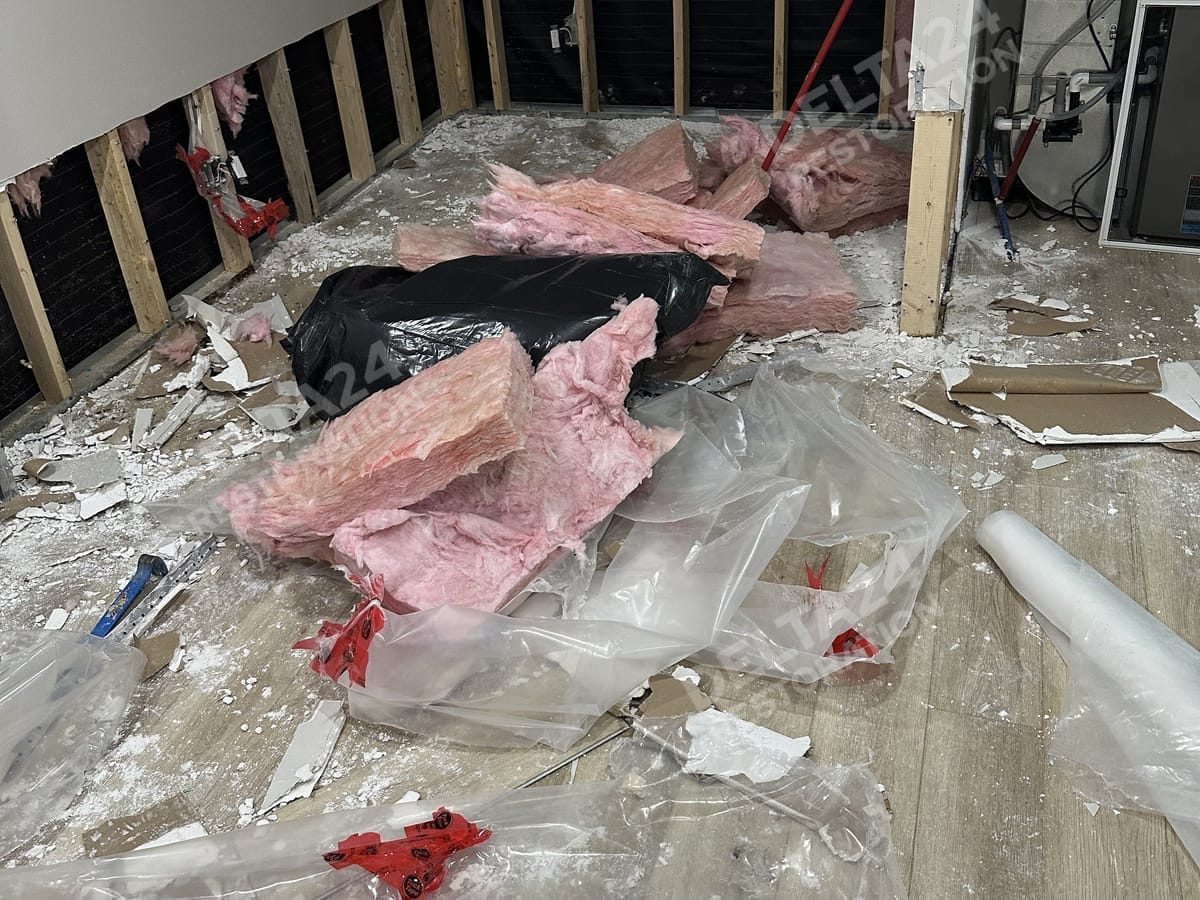
- Removal of affected drywall, insulation and flooring
- HEPA vacuuming and antimicrobial treatment of framing
- Dehumidification to bring the space back to normal
- Advice on preventing recurrence, including waterproofing where relevant
- Written post-remediation verification
- Rebuild of what was removed
Who we do this for
- Homeowners with finished and unfinished basements
- Basement apartment landlords and tenants
- Buyers and sellers
- Property managers
- Owners of older homes with block foundations
When to call us in Vaughan
When you notice the smell, not when you can see the growth. By the time it is visible on the surface of drywall it is usually well established on the back of it.
What basement mould removal in Vaughan costs you
We bill your insurance company directly. On most covered losses that is the only amount you pay us.
Water damage is the most common home insurance claim in Ontario, and the great majority of the work we do is paid by an insurer rather than by the property owner. We document every loss from the first hour with moisture readings, photographs and a written scope, which is the evidence an adjuster needs to approve the work without argument or delay.
We work with all major Canadian insurers and handle the claim from start to finish, including the adjuster's questions. If you are not insured, or the loss falls outside your policy, we will give you a clear written quote before any work begins and we will tell you honestly what can be dried and saved rather than replaced. Keeping material in place is what keeps the cost down, and it is the first thing we look at.
There is no charge for attending to assess an emergency, and no obligation once we have. What your policy covers →
Who turns up in Vaughan
Delta24 Restoration is a professional restoration contractor serving Toronto and the Greater Toronto Area. Our technicians are certified by the IICRC, the industry standards body for the restoration trade, in Water Damage Restoration (WRT) and Applied Structural Drying (ASD). We are WSIB cleared and carry full commercial general liability insurance. Certificate numbers and a current clearance certificate are provided on request, and property managers and adjusters routinely ask for both before we attend.
We work to the IICRC S500 standard for water damage restoration and the S520 standard for mould remediation. Every job is documented with daily moisture readings, photographs and a written scope, which is why adjusters approve our work without delay.
Asbestos work is carried out to Ontario Regulation 278/05, which sets out the procedures for Type 1, Type 2 and Type 3 operations. Mould work finishes with written post-remediation verification, which is the document a buyer, a lender or an insurer will ask to see.
- IICRC WRT certified technicians
- IICRC ASD certified drying
- WSIB cleared, certificate on request
- Commercial general liability insurance
- Asbestos work to O. Reg. 278/05
- Direct billing with all major Canadian insurers
- Years of insurance claim experience with every major insurer
- Written post-remediation verification on mould work
- Free assessment, no obligation
How the insurance side works
Water damage is the most common home insurance claim in Ontario, and how the claim is handled usually matters more to your bill than the work itself. We document the loss from the first hour: moisture readings, photographs, a written scope, and a daily drying log. That is the evidence an adjuster needs to approve the work without arguing about it.
We bill your insurer directly. In most cases the only money you hand over is your deductible, which on Ontario policies commonly sits between $500 and $2,500.
Which losses are covered depends entirely on where the water came from. A burst pipe or a failed appliance is normally covered under a standard policy. Water coming up through a floor drain is sewer backup, which is almost always a separate endorsement you have to have purchased. Water entering from outside during heavy rain is overland flood, which is another endorsement again. A single storm can produce all three at once, which is why adjusters care so much about the source.
Full guide: is a flooded basement covered by insurance? →
How the claim works, and what your insurer covers →
Common questions
My finished basement flooded. Does the second kitchen complicate it?
It adds scope. Cabinetry, an island, tiled floors and a bathroom all have to be assessed separately, and cabinet kick spaces hold water that is easy to miss. We check them as a matter of course.
How fast can you reach Woodbridge or Kleinburg?
We run to Vaughan daily. Woodbridge and Maple are usually within 45 minutes; Kleinburg a little longer depending on the time of day.
Why does my basement smell musty?
A musty smell is microbial growth somewhere, even where nothing is visible. It is commonly behind drywall, under flooring or inside a cold room. Finding the moisture source is the first job.
Can I finish my basement after mould removal?
Yes, once the source is fixed, the area verified and the space dried. We can carry out the rebuild ourselves so it goes through as a single job.
Should I put a dehumidifier in my basement?
It helps control humidity and is worth running through the summer, but it will not fix water entering through the foundation or a failed drain. It manages the symptom.
What will basement mould removal cost me?
It depends whether it follows a covered water loss, in which case it usually goes on that claim and you pay your deductible. Otherwise we inspect, scope the work in writing and quote it before starting. We price to the area that actually needs remediating rather than the whole basement.